We're launching the Democratic Tech crowd fund platform
A network of collectives and organisations across Europe is launching a collective funding platform for democratic technology. It is for the tools, spaces and mobilisation we need, to face one of the defining challenges of our time: the alliance between Big Tech corporations and authoritarian political forces. Some call it the digital coup, the authoritarian stack, or technofascism.
A platform to crowd fund democratic tech
Building communication infrastructures in our own cities and regions
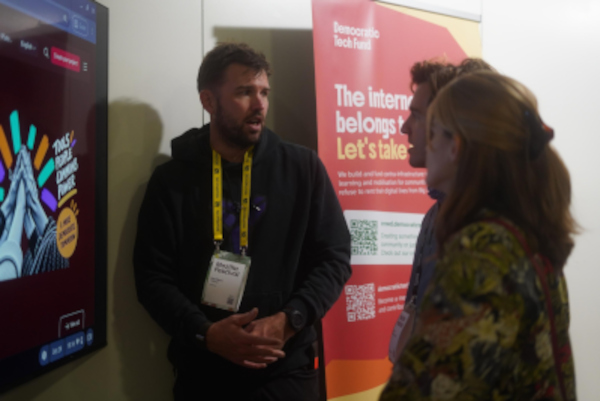
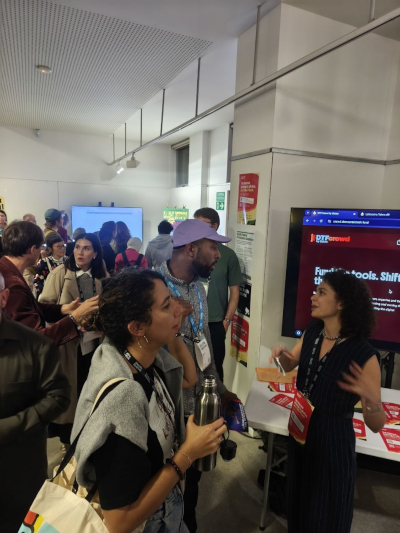
29 October 2026. Today a network of collectives and organisations across Europe is launching a collective funding platform for democratic technology. Part of its members have assembled at the Mozilla Festival during the Open Tech Week in Barcelona. The Democratic Tech Fund presents its crowd fund platform. Here in Barcelona, together with and based on many commons based experiences, we propose to work hand in hand to drive the change that we need, based in solidarity, international networking, shared responsibility and the will to learn from and with each other.
The technology to build alternatives already exists, and so do inspiring examples. What has been missing is the will, and the means, to build them together. So we are proposing to crowdfund, and pay, teams willing to do this work. They should be rooted in a community, use open, decentralised technology, and follow models others can replicate.
Why this, why now
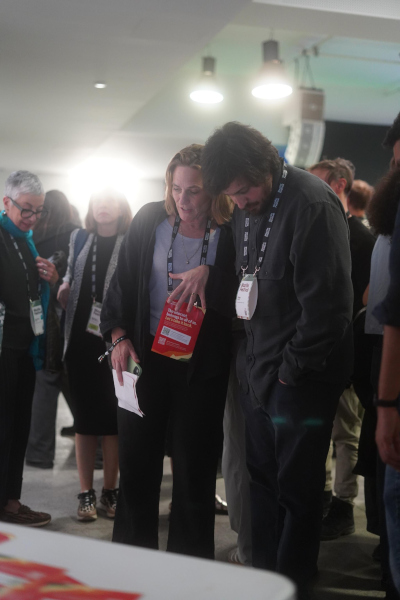
Much of our daily communication happens inside systems designed to capture our attention and shape public discourse. A handful of opaque corporations and investment funds decide which stories get seen and which disappear under an extractive algorithm. When the channels we use to inform ourselves and talk to each other are treated only as financial assets, creative and journalistic work becomes precarious, and democratic pluralism suffers. So does our capacity to imagine other possible worlds.
Complaining about this, or resigning ourselves to it, won’t change it. What will change it is building and owning our own infrastructure, on servers, in social spaces and on the streets of our cities: networks of collective ownership where social value comes before the profits of a few.
Stories from the fringes
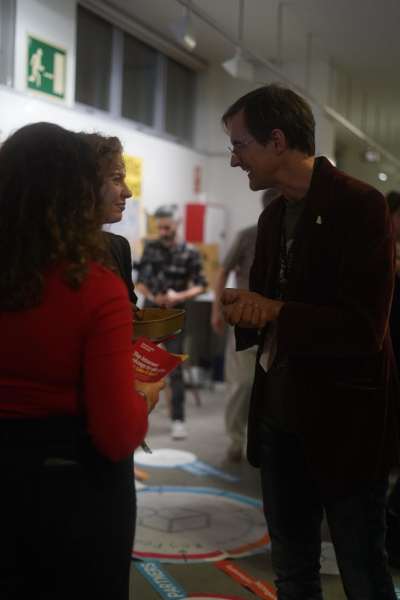
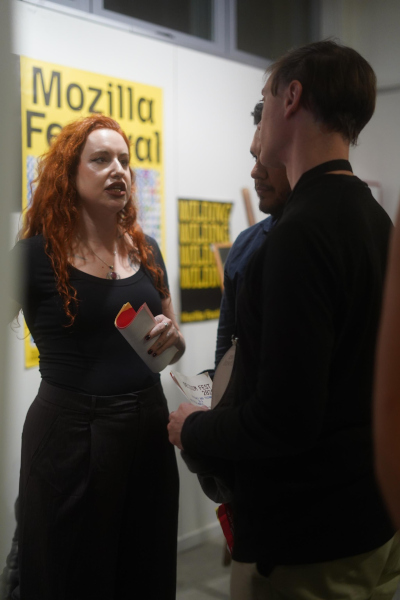
We have interviewed and documented projects that inspire us, and we work alongside many of them. Some are collaborative workspaces. Some are connected community spaces. Others include archives & care and co-operative tools for the social and solidarity economy. All of them are cases you can pick up and reuse for your own community. Read the stories
There are also developments many communities need, where a relatively small effort could make a real difference. That lets us move quickly to rebuild our collective resilience in one of our most basic needs: powerful communication infrastructures.
Beyond resignation
Many people feel there is no way out of dependence on the platforms owned by the ultra-rich, from GAFAM to the new AI giants. It is hard to see past the machinery that keeps our attention stuck in Instagram and TikTok, and determines what we see in Google. Yet more people than ever, across all parts of society, recognise the damage these platforms do: polarisation, addiction by design, the amplification of the radical right, and the exclusion of social movements from public discourse.
We propose a coalition of the willing, forming around campaigns on the platform. Besides practical projects, we also welcome games and playful campaigns that help people take the step. These campaigns can connect to the networks already moving in this direction, such as the Digital Independence Days (#DIday), #VamonosJuntas and #DoeiDag.
Call for Projects
We invite projects to campaign on the platform in the following areas, which appear as “shelves” on the platform:
- Archicare supports feminist and community-led projects that preserve collective memory and turn archives and lived experience into infrastructures for care, resistance and collective action.
- Decentralised infrastructures building community-owned, cooperative and federated alternatives to platform dependency
We are especially looking for projects that already have at least an initial community behind them. We also want projects willing to develop a sustainable model that combines decent technology, communication and community organising. None of these alone is enough. We don’t believe in “build the tech and the users will come.” Building something socially useful and viable takes a concerted effort.
That is what we mean by democratic tech: tools and infrastructure in the hands of a community that organises itself, takes care of each other, and decides its own direction.
Selection criteria
Proposals will be assessed on whether they:
- meet a social need in collective communication infrastructure, with priority for the shelves above;
- have an initial driving team and a community behind them;
- are clearly community-centred;
- plan for diverse income beyond the crowdfunding campaign, such as subscriptions, donations and, where relevant, public or private grants;
- have a realistic outreach strategy to spread the word and grow their community;
- describe an operational model that may combine voluntary, in-kind and paid work;
- share knowledge both within their community and with related projects;
- involve their community in strategy and decision-making.
These criteria follow the five pillars of democratic tech that guide all DTF work: Community centredness, Shared Knowledge, Co-governance, Co-production, and Mobilising Diverse Income.
What we offer
A platform. The platform is built with Fundación Platoniq, the organisation behind Goteo.org, the open-source crowdfunding platform for social projects running since 2011 and mobilising more than 25 million euro in donations between over 400.000 people to thousands of social projects. The DTF was initiated by the Free Knowledge Institute, Fundación Platoniq, Commons Network and Waag Futurelab.
Funding scale. Campaigns on the platform set two targets. The minimum budget is what the project needs to go ahead, and the optimal budget is what it would do with more. We expect minimum budgets of roughly €5,000–20,000 and optimal budgets of €10,000–50,000. Exceptionally strong proposals may justify more.
A community. We will offer support where it is needed and where we can. This includes help sharpening your proposal and organising your project around the five pillars. The DTF is a growing community of people building communication infrastructure in our cities and regions, and anyone who wants to contribute is welcome to join as a member. Link to join form: https://democratictech.fund/join/.
Timeline
- 29 October: call opens. Go to http://crowd.democratictech.fund/ login with your DTF account and go to create project. Register your project and add details to it on the go.
- DTF member organisations who act as funding stewards assess incoming projects and give feedback. Projects that are ready can start their campaign on a rolling basis. Depending on a project’s urgency and readiness, the period between submission and launch can be as short as one month.
- Early 2027: we expect the first projects to launch their campaigns
About donations
Currently two foundations handle the financial flows of the DTF:
- the Free Knowledge Institute, a public-benefit foundation in Amsterdam acts as fiscal host and custodian for the DTF, e.g. for membership contributions made through Open Collective. The FKI is registered in the Netherlands as an ANBI (public benefit organisation), so donations from Dutch taxpayers may qualify for tax relief.
- Fundación Platoniq operates the crowd fund platform and receives all donations made through it in custody. As a Spanish public benefit organisation, donations merit tax relief for Spanish residents. Check the details.
About Donations and tax relief; in principle inside the European union, due to the harmonisation efforts of member states, tax relief rules applied to national residents should be equal for foreign residents from other EU member states. However fiscal reality maybe harsh and we recommend checking with your fiscal authorities.
About payouts
When a campaign closes successfully, the project receives the funds raised, paid either to members of its driving team or to its organisation. Payouts follow the budget and plan set out in the campaign. Projects are recommended to define realistic milestones in their budget; enabling the verification of results before payout. A community audit team reviews delivered results against the campaign’s plans and commitments.
How the DTF sustains itself
The DTF runs on its members: their financial contributions, their voluntary work, and the paid work of a small driving team. Its income comes from donations, membership fees and a small share of each campaign budget. We ask projects to reserve 10% of their budget to support the platform and the driving team.
Join us. [Become a member · Crowd fund · Donate · Contact]