Getting started: our co-creation day in Amsterdam
On 19 February a dozen people met at Internet Archive Europe to work out how to get the Democratic Tech Fund off the ground. This is the story of where we started.
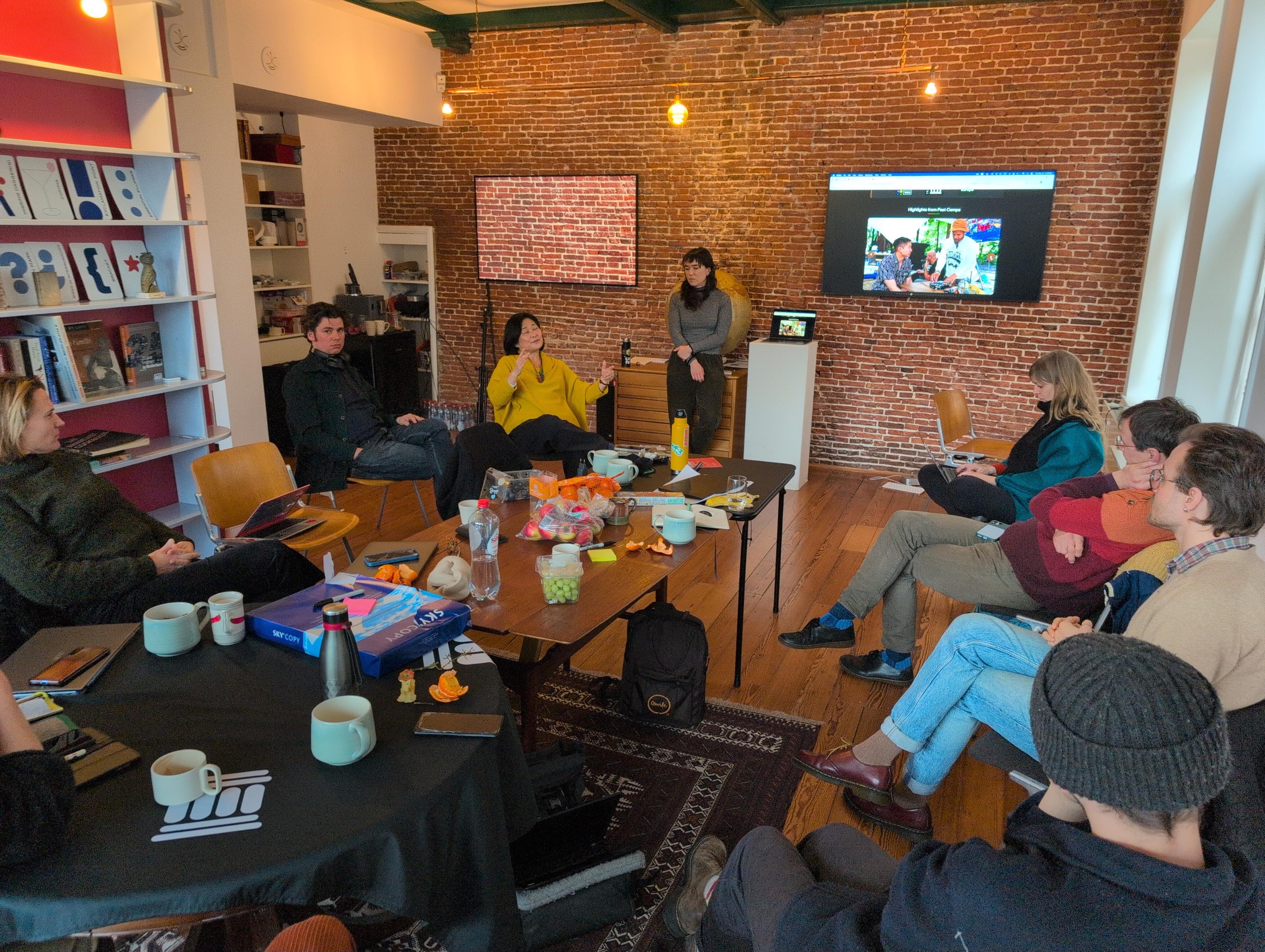
On 19 February 2026, about a dozen people gathered at the Amsterdam office of Internet Archive Europe for a day of co-creation. The meeting was convened by the DTF Council of Stewards, which has met every month since November 2025 to develop the concept of the Democratic Tech Fund. This time the question on the table was a practical one: how do we actually get this off the ground?
Why we started
Big Tech is increasingly aligned with authoritarian political forces. The privatisation of the internet is accelerating, and with it the damage to our planet, to democratic societies and the harm done to marginalised communities.
At the same time, there is no shortage of good technology. There are many inspiring community experiences, and many models we can learn from, adopt and adapt. What we lack is coordination — and funding sits at the heart of that problem.
Most public funding is not designed to build the social capacity needed for a cultural shift towards self-organisation and autonomy. EU programmes and funds such as NLnet’s are valuable, but they focus on the technology itself, not on the people and communities who need to adopt, run and sustain it.
What we propose
A bottom-up fund that broadens our social capacity in the transition towards collective digital autonomy. Put simply: we want powerful digital communications infrastructure in the hands of communities, in our cities and regions.
Who we are
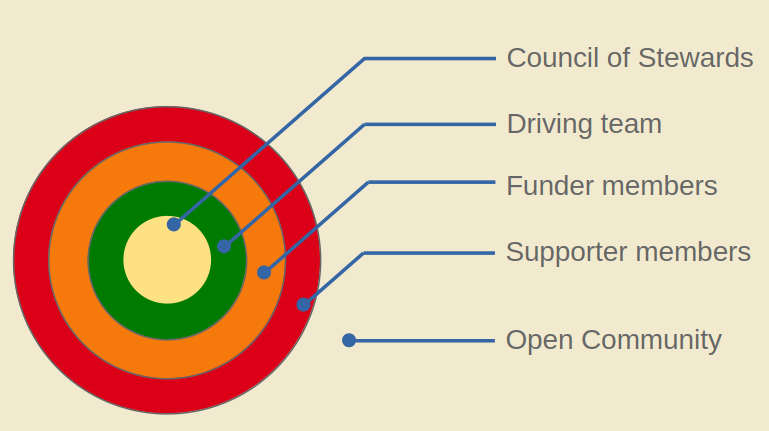
The DTF was initiated by four foundations: the Free Knowledge Institute, Commons Network, Waag Futurelab and Fundación Platoniq. Other co-founders have joined since. We are shaping the membership around the following model as in the diagram.
How we organise
Governance. A Council of Stewards holds the initiative together and has met monthly since November 2025. On the co-creation day, the first working groups started.
Infrastructure. We work closely with the Co-op Cloud community, and the DTF has become a member of the Co-op Cloud Federation.
Three forms of work. We proposed three ways to contribute:
- voluntary work, or ‘love work’ — work done for love of the cause;
- voluntary work in exchange for membership;
- paid work, or livelihoodwork, once there is income to pay for the labour.
Legal form. We have not set up a new legal entity yet. The DTF is held together by the four founding foundations and fiscally hosted by the Free Knowledge Institute.
A sustainability model with community at the centre
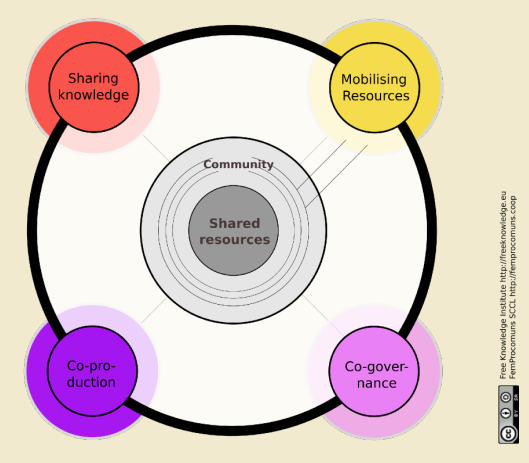
- Community at the centre. The members are the fund.
- Shared knowledge. Everything we learn is shared openly, so that others can replicate it.
- A diverse revenue mix. Membership contributions, donations, grants, and a share of crowdfunding (right now: 10%) to pay for the driving team.
- Co-production. Work happens in working groups or circles, following sociocratic, consent-based practice.
- Co-governance. The Council of Stewards holds things together for now. The aim is democratically governed infrastructure in which members take responsibility for both its sustainability and its governance.
Next milestone: DWeb Camp
We set ourselves a clear goal: to be present at DWeb Camp and introduce the DTF to the DWeb community as our moment of going live. (spoiler: we went there in July and had a great event, see post here).
To get there, we agreed to use the months in between to get our membership proposition right, make it easy for new members to register themselves, and put a website online that explains what we are about. Four working groups took this on.
Funding
- Raising funds for key parts of our work.
- Setting up a crowdfunding platform based on Goteo, together with Fundación Platoniq.
Organising
- Membership.
- Strategy, stewarded by the Council of Stewards. Condensed in the foundational documents, with a vision, mission statement, a Social Contract as proposed to our membership, and a Code of Cooperation.
- Finances and legal matters, in the custody of the Free Knowledge Institute.
- Recruiting key staff for the other groups.
- A subgroup working on DTF tooling.
Community
- We see ourselves as a transition community: people and organisations moving towards collective digital autonomy and sharing their path, based on mutual aid and solidarity.
- Organising community events, starting with online gatherings hosted by member organisations.
Storytelling and outreach
- Developing stories and use cases.
- Developing our narrative and visual identity.
- Building the DTF website and outreach materials.
A first story: eCommons joins and builds
Among the participants that day was decentral1se, co-founder of the Co-op Cloud Federation. Also in the room was eCommons, a cooperative that supports Amsterdam’s community economy with digital commons services, represented by its co-founders Danny and Sergei.
By the end of the day, eCommons had decided to become a co-founding member of the DTF. As their membership contribution, they committed three hours of maintenance work per month on the DTF’s tooling. With some mentoring from decentral1se, they deployed a basic Co-op Cloud set-up for the DTF: one account per member to access the different services, starting with a documentation server based on Outline.
It did not stop there. eCommons went on to become an active part of the Co-op Cloud Federation itself — a small example of how contributing in kind can strengthen the wider ecosystem, not just the DTF.
Join a working group
Would you like to join one of the working groups? Please first become a member and let us know you would like to contribute in kind. Or write to us at dtf@democratictech.fund.
We could especially use a few more creative organisers, storytellers and connectors for the commons.